Through our grandmother Emily Trombley, our family is French. French and not French-Canadian, Grandma would insist, because that was the tradition handed down in her family. They were French on both sides; on one side, she was descended from the original founders of Détroit, in New France, around 1700. Her Trombley side, on the other hand, was French Canadian, and had come to the Detroit region from Québec in the mid-18th century, a generation later than some of her fourth great-grandparents on the Reno (Renaud) side.

An article in the Detroit News published in 2013, around the time of Detroit’s 300th anniversary, describes the community of current descendants from those original French founders. It focuses on, among others, Thomas St. Aubin of St. Clair Shores, whose name, like those of so many other French ancestors is a Detroit street name.
Emily Trombley, and so we (i.e., my half-siblings), was, on her Reno (Renaud) side, descended from St. Aubin ancestors. Here are other Detroit-area street names that appear in our family tree going back ten generations. Some of them are only relatives by marriage, and others contributed their DNA to our dad and his children.
- Alard
- Casse
- Forest (La Forêt, La Forest)
- Forton (Fréton)
- Fournier
- Peltier (Pelletier)
- Rivard
- Trombly (Tremblay and many variations)
Emily’s great-great grandfather Joseph Trombley was born in Québec, in the Baie-Saint-Paul community, on October 5, 1745. Before he reached adulthood he came to Detroit, where he married Magdelaine Mesnil (Mesny, Meny are the other spellings of the name) on April 11, 1768 at Ste. Anne’s church in Detroit. This was about 50 years after the founding of the village, which numbered about 800 people in 1765. Joseph Trombley’s own great-grandfather, Pierre (our 7G grandfather), was the original French emigrant who was born in Randonnai, Perche, France in 1626, and died in Québec sometime between the late 1670s and late 1680s. The French-Canadian Genealogist provides a great illustrated history of what is known of the life of Pierre Tremblay and his wife, Ozanne Achon. We are descended from their second son (fourth child), Michel Tremblay and his wife, Genevieve Bouchard.
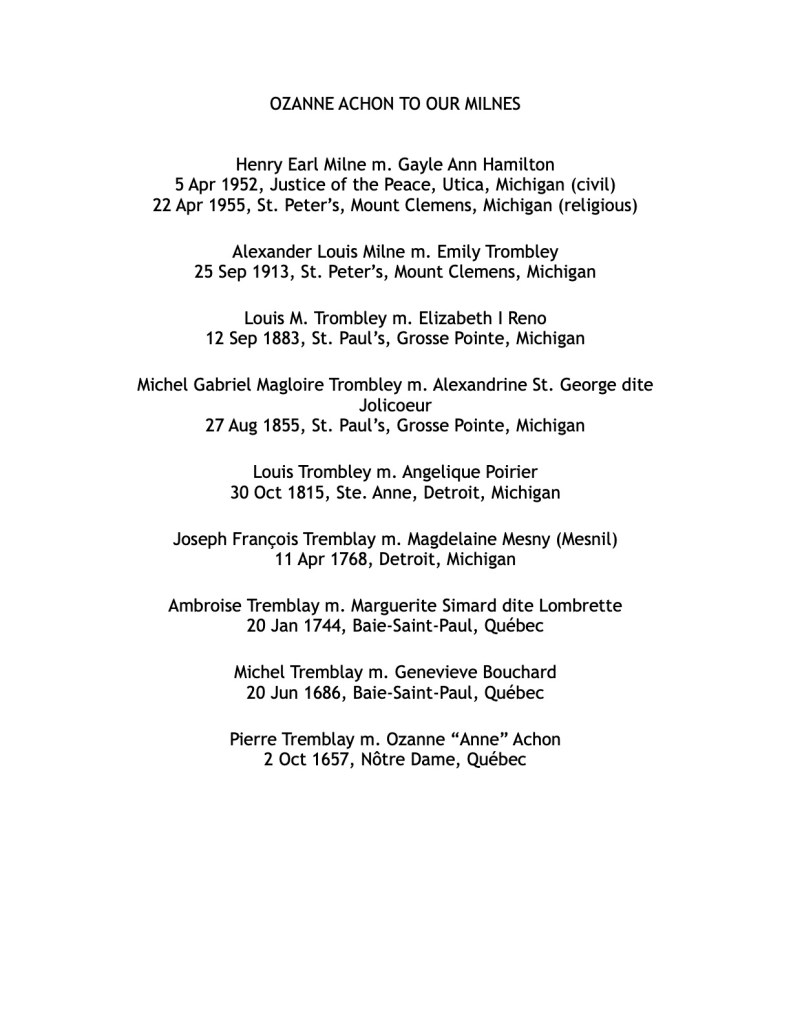
Because of these ancestors, one of the features of our American-French family is that we are straight-line descendants of one (or more?) Filles à Marier, who came to Quebec before the Filles du Roi. The filles à marier, or “marriageable girls,” were offered no premium to come, but only a chance to be married in the new world. Here is the straight-line descendant chart for our family back to Ozanne, or Anne, Achon. Ozanne came to Québec and married Pierre Tremblay. They are the progenitors of the Tremblay family in America. The Tremblay Association of North America, which has its own website and periodic gatherings, exists to “unite all the Tremblays in North America and create a feeling of unity, pride and true membership.” The association has published a detailed history of the plaques and monuments they have constructed in honor of our Tremblay ancestors. Monuments et plaque en homage a nos ancetres (PDF), in French, has terrific pictures, as well, like the one below of Ozanne Achon.

According to Kim Kujawski at The French-Canadian Genealogist, “Today, it is estimated that over 9,000 Tremblay families live across North America, representing about 180,000 people. 13% of all Quebeckers are named Tremblay! In Les Éboulements, one in three residents is a Tremblay.” The number of married-out DNA descendants with a name other than Tremblay (like us) must be many times that 180,000.


There is a larger than life-size statue of the original Pierre Tremblay in L’Ange Gardien, Quebec, entitled the father of my people, surrounded by children.
LikeLike
I am decsended from Ambroise Tremblay. Forton, Peltier, Rivard, Renaud, Saucier, Casse dit St. Aubin, Meny, Gagnon, Gagne, Trottier, Fortin de Bellefontaine, Dequindere, Chapoton, Picot de Bellestre and Yax(the 1st Grosse Pointe Germans) Grew up in Mt. Clemens, parents also married in 1955. Would love to compare trees.
Going to Perche in September 2026 to visit our origins in France.
LikeLike